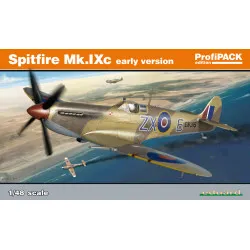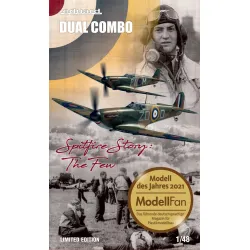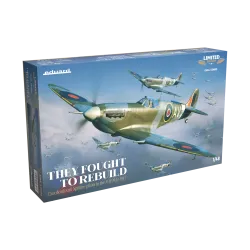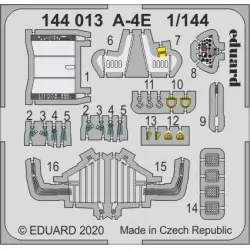






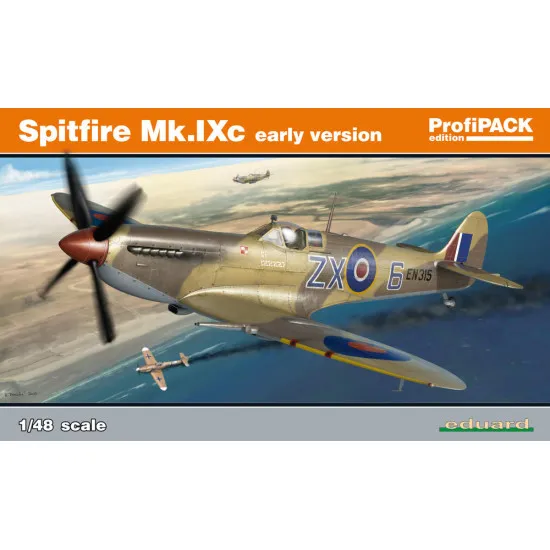
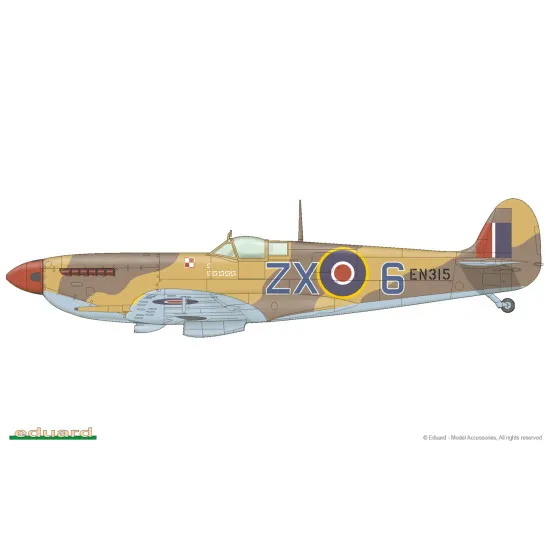
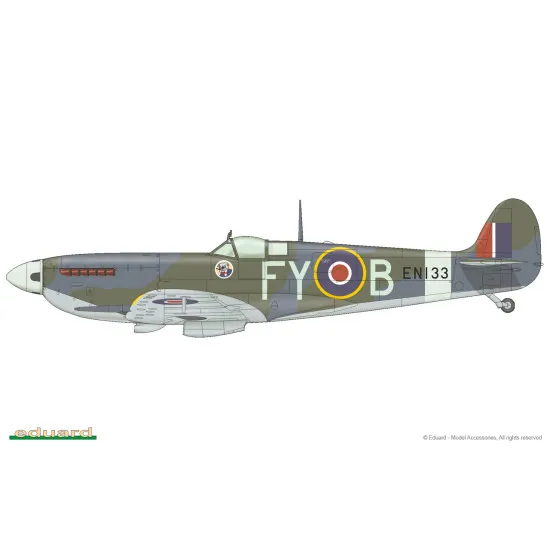
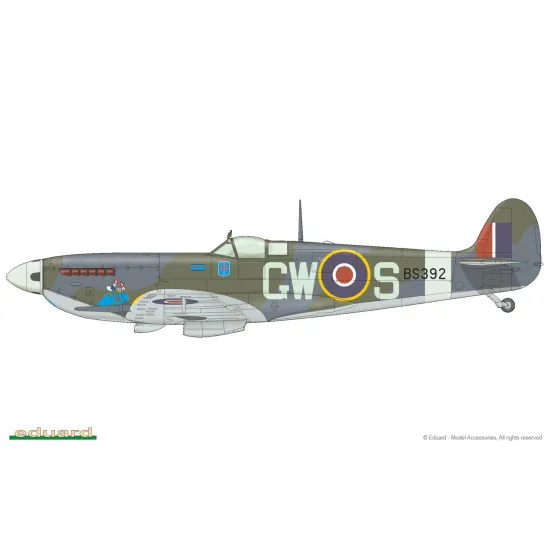
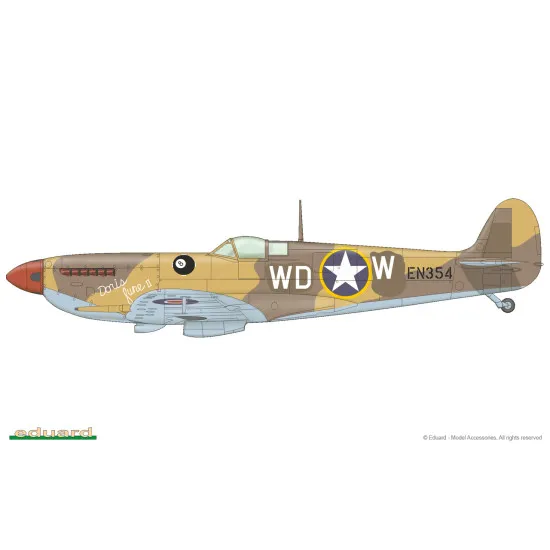
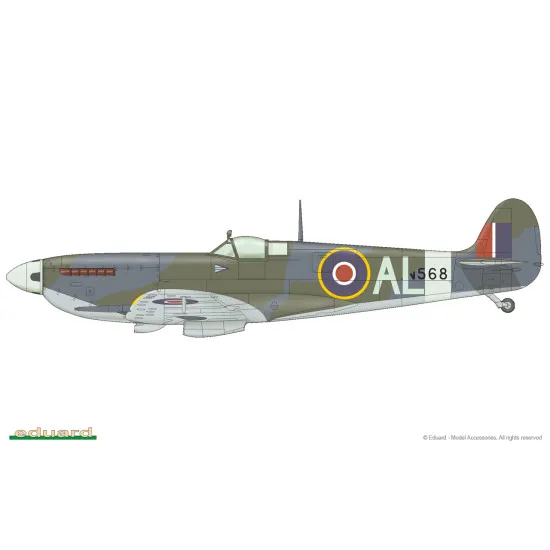
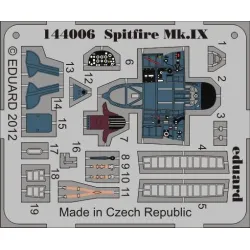
Spitfire Mk.IXc (early version), Profipack edition
1/48 Aircrafts, Planes
Eduard - 8282
Manufacturer: Eduard (Czech)
Material: Plastic
Scale: 1/48
Condition: New
The Supermarine Spitfire is a British single-seat fighter aircraft that was used by the Royal Air Force and many other Allied countries during and after the Second World War. The Spitfire was built in many variants, using several wing configurations, and was produced in greater numbers than any other British aircraft. It was also the only British fighter to be in continuous production throughout the war. The Spitfire continues to be a popular aircraft, with approximately 50 Spitfires being airworthy, while many more are static exhibits in aviation museums all over the world.
The Spitfire was designed as a short-range, high-performanceinterceptor aircraft by R. J. Mitchell, chief designer at Supermarine Aviation Works (which operated as a subsidiary of Vickers-Armstrongfrom 1928). In accordance with its role as an interceptor, Mitchell designed the Spitfire's distinctive elliptical wing to have the thinnest possible cross-section; this thin wing enabled the Spitfire to have a higher top speed than several contemporary fighters, including theHawker Hurricane. Mitchell continued to refine the design until his death from cancer in 1937, whereupon his colleague Joseph Smith took over as chief designer, overseeing the development of the Spitfire through its multitude of variants.
During the Battle of Britain (JulyâOctober 1940), the Spitfire was perceived by the public to be the RAF fighter, though the more numerous Hawker Hurricane shouldered a greater proportion of the burden against the Luftwaffe. However, because of its higher performance, Spitfire units had a lower attrition rate and a higher victory-to-loss ratio than those flying Hurricanes.
After the Battle of Britain, the Spitfire superseded the Hurricane to become the backbone of RAF Fighter Command, and saw action in theEuropean, Mediterranean, Pacific and the South-East Asian theatres. Much loved by its pilots, the Spitfire served in several roles, including interceptor, photo-reconnaissance, fighter-bomber and trainer, and it continued to serve in these roles until the 1950s. TheSeafire was a carrier-based adaptation of the Spitfire which served in the Fleet Air Arm from 1942 through to the mid-1950s. Although the original airframe was designed to be powered by a Rolls-Royce Merlin engine producing 1,030 hp (768 kW), it was strong enough and adaptable enough to use increasingly powerful Merlin and, in later marks, Rolls-Royce Griffonengines producing up to 2,340 hp (1,745 kW); as a consequence of this the Spitfire's performance and capabilitiesimproved, sometimes dramatically, over the course of its life.he British public first saw the Spitfire at the RAF Hendon air-display on Saturday 27 June 1936. Although full-scale production was supposed to begin immediately, there were numerous problems which could not be overcome for some time and the first production Spitfire, K9787, did not roll off the Woolston, Southampton assembly line until mid-1938.[1] The first and most immediate problem was that the main Supermarine factory at Woolston was already working at full capacity fulfilling orders for Walrus and Stranraer flying boats. Although outside contractors were supposed to be involved in manufacturing many important Spitfire components, especially the wings, Vickers-Armstrong (the parent company) was reluctant to see the Spitfire being manufactured by outside concerns and was slow to release the necessary blueprints and subcomponents. As a result of the delays in getting the Spitfire into full production, the Air Ministry put forward a plan that production of the Spitfire be stopped after the initial order for 310, after which Supermarine would build Bristol Beaufighters. The managements of Supermarine and Vickers were able to convince the Air Ministry that the problems could be overcome and further orders were placed for 200 Spitfires on 24 March 1938, the two orders covering the K, L and N prefix serial numbers.
Supermarine Spitfire
Spitfire LF Mk IX, MH434 being flown by Ray Hannain 2005. This aircraft shot down a FW 190 in 1943 while serving with 222 Squadron RAF.
Role
Fighter / Photo-reconnaissanceaircraft
Manufacturer
Supermarine
Designer
R. J. Mitchell
| General Product Info | |
| Material | NOT SET |
| Scale | 1/48 |
| Type | NOT SET |
We have the lowest worldwide shipping. And it's totally simple.
EUROPE, USA, CANADA TURKEY, ISRAEL, EGYPT, UE CHINA, JAPAN, HK, S.KOREA | AU NZ MX South America, Asia | |
| Order weight up to 0.22kg or 0.48lb | US$ 8.90 | US$ 8.90 |
| Order weight up to 0.44kg or 0.97lb | US$ 13.95 | US$ 17.90 |
| Order weight over 0.44kg or 0.97lb | US$ 19.99 | US$ 29.99 |
| Order total over $150 | FREE | PROMO US$ 19.99 |
Shipping to some countries not qualifies for the free shipping option but costs not over $29.99 for any sized order. Sorry for that, your location is too far.
- Stock: Out Of Stock
- Model: EDU-08282
- Weight: 0.20lb
- DATE ADDED: 04/04/2014