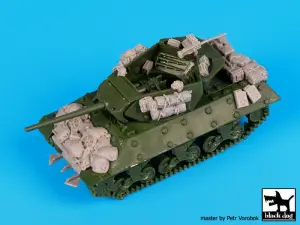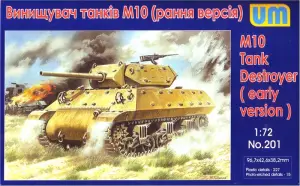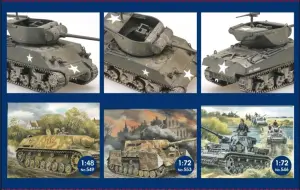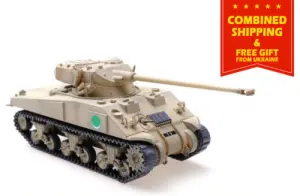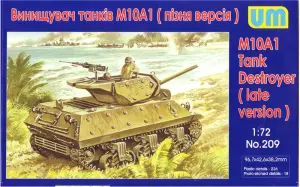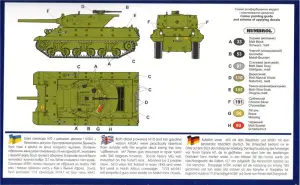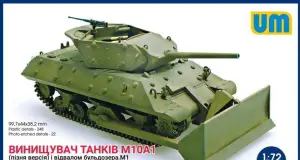

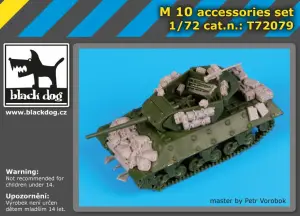
M10 Tank Destroyer (late version) WWII
1/72 scale plastic military VEHICLE model kit from WWII
UniModels (UM) 202
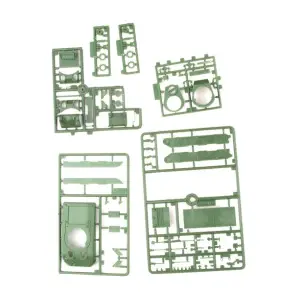
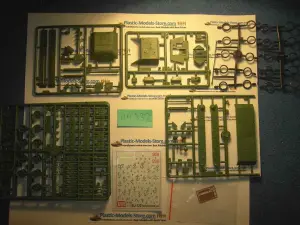
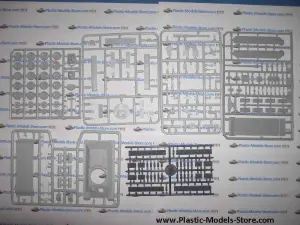
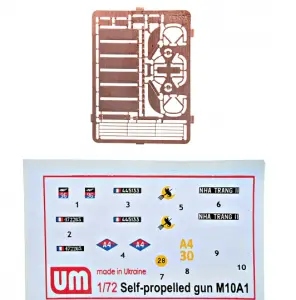
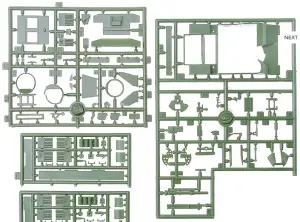
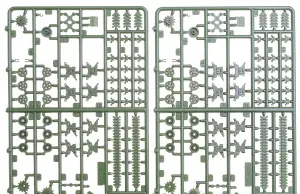
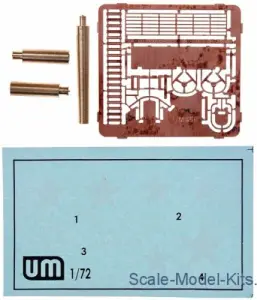
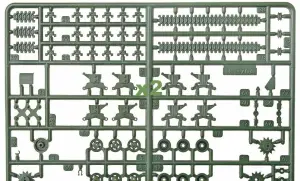
Parts count: 227 plastic parts plus 15 photo-etched parts
The M10 tank destroyer, officially the 3-inch Gun Motor Carriage M10, was a World War II United States tank destroyer built on the chassis of the M4 Sherman tank. It was the most numerous U.S. tank destroyer of the war and paired a capable anti-tank gun with a traversing turret, unlike the earlier M3 GMC whose gun could only traverse to a limited degree. Although more powerful successors were introduced, it stayed in service until the war's end, and some of those successors were in fact converted or rebuilt from the M10 itself.
The British nicknamed it the Wolverine, but unlike names such as the M4 Sherman, that name never caught on with American troops, who referred to it as the TD (a general nickname for any tank destroyer) apart from its official designation. On the eve of World War II, US combined-arms doctrine assigned tanks the roles of infantry support and exploitation, while the anti-tank mission went to a new branch, the tank destroyer force. Tank destroyer units were designed to counter German blitzkrieg tactics: held in reserve at corps or army level, they would rush to any enemy tank breakthrough and aggressively hunt down enemy armor. This demanded very fast, heavily armed vehicles. Although fitted with turrets (unlike most tank destroyers of the period), the typical American design carried a heavier gun but lighter armor than a contemporary tank, and thus was more maneuverable. The concept was to rely on speed and agility rather than thick armor to bring a powerful self-propelled gun into action against enemy tanks.
The 3-inch Gun Motor Carriage T35 was the prototype of the M10. It mounted a 3-inch (76.2 mm) gun in a new sloped, circular, open-topped turret, developed from the Heavy Tank T1/M6 turret and fitted to an early-production Medium Tank M4A1 hull. The production M10 used a Medium Tank M4A2 chassis (M10A1s used the M4A3 chassis), carrying an open-topped turret with a 3" gun M7. This gun fired the M79 Armor Piercing shot, capable of penetrating 3 inches of armor at 1,000 yards at 30 degrees from vertical. Other ammunition carried throughout its service life included the M62 Armor Piercing Capped Ballistic Cap (APCBC) projectile, the M93 High Velocity Armor Piercing (HVAP) shot, and Armor Piercing High Explosive (APHE) rounds; 54 rounds of 3-inch ammunition were carried. Two large counterweights at the rear of the turret gave it a distinctive silhouette. The main weakness of the 3-inch cannon was its APHE round, the type most often used against tanks. Based on the naval 3-inch round, it had a small charge at the rear meant to explode after penetrating the target's armor. Unfortunately it was found to detonate on impact or shortly after, so the round often failed to penetrate. Why this problem was never solved with a better base fuse or by removing the small HE charge remains a puzzling mystery. The same issue affected the towed 3-inch M5 cannon in the anti-tank role. In its combat debut in Tunisia in 1943 during the North African campaign, the M10 proved successful, as its M7 3-inch gun could destroy most German tanks then in service. The M10's heavy chassis did not fit the tank destroyer doctrine of very light, high-speed vehicles, so from mid-1944 it was supplemented by the 76mm Gun Motor Carriage M18 "Hellcat". Later in the Battle of Normandy, the M10's gun proved ineffective against the frontal armor of the newer German Tiger and Panther tanks unless firing HVAP rounds,[6] but it was effective against the most common tanks, such as the Panzer IV medium tank, and against lighter vehicles and self-propelled guns. Tank destroyer units had been reinforced with 90mm towed guns in partial anticipation of heavier German tanks, but their lack of mobility made them difficult to employ. By fall 1944 the improved 90mm Gun Motor Carriage M36 had begun arriving in Europe as well. In the Pacific war, US Army M10s were used for infantry support, but were unpopular because their open-topped turrets made them more vulnerable than a fully enclosed tank to Japanese close-in infantry attacks.
3-inch Gun Motor Carriage M10
Type
Tank destroyer
Place of origin
United States
Production history
Designed
1942
Manufacturer
General Motors
Ford
Produced
1942–1943
Number built
6,706
Specifications
Weight
29.6 metric tons (65,000 lb)
Length
6.83 m (22.41 ft) including gun
5.97 m (19.6 ft) hull
Width
3.05 m (10 ft)
Height
2.57 m (8.43 ft)
Crew
5 (Commander, 3 gun crew, driver)
Armor
9 to 57.2 mm (0.3 to 2.3 in)
Main
armament
3" (76.2 mm) Gun M7
54 rounds
Secondary
armament
.50 in (12.7 mm) Browning M2HB machine gun
300 rounds
Engine
General Motors 6046 diesel (conjoined twin 6-71s)
375 hp (276 kW)
Power/weight
12.5 hp/t
Suspension
Vertical Volute Spring Suspension (VVSS)
Operational
range
300 km (186 mi)
Speed
51 km/h (32 mph)
United States · Airmail with tracking · delivery ~14 days.
Change the country in the shipping box above.
| Box weight (products) | Price |
| 0.00 lb – 0.49 lb | $8.90 |
| 0.49 lb – 0.97 lb | $12.99 |
| 0.97 lb – 1.94 lb | $19.99 |
| 1.94 lb – 220.46 lb | $22.99 |
| Order over $150.00 | FREE |
This product weighs 0.30 lb.
There are no reviews for this product yet.