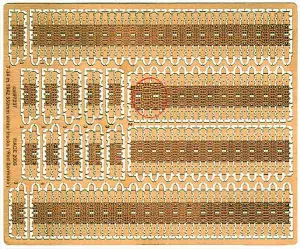
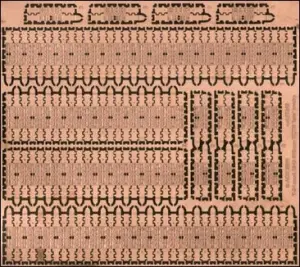
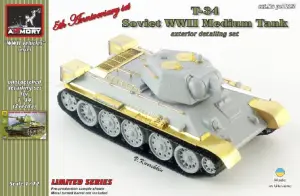
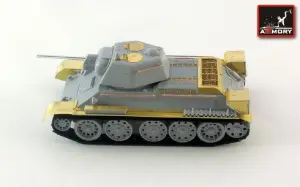
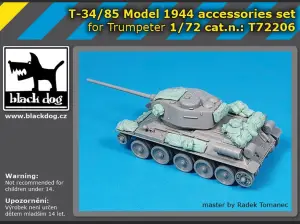
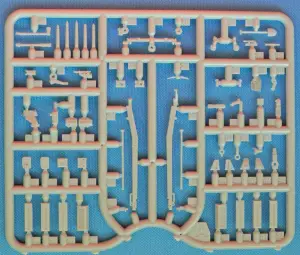
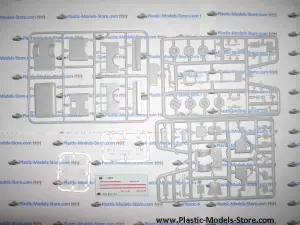
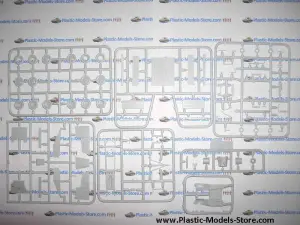
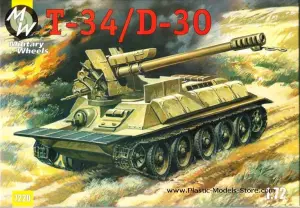
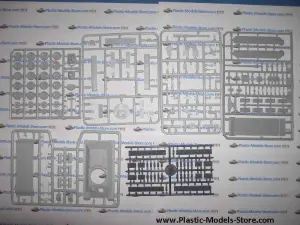
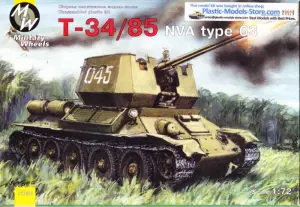
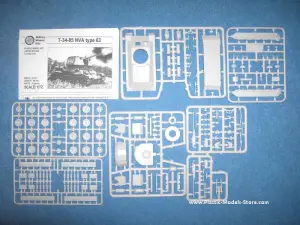
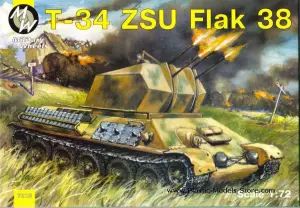
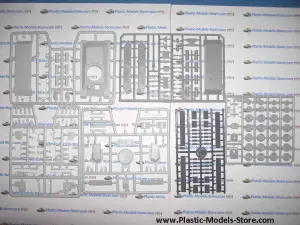
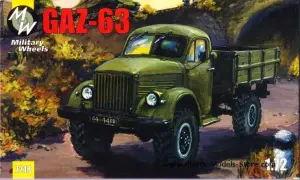
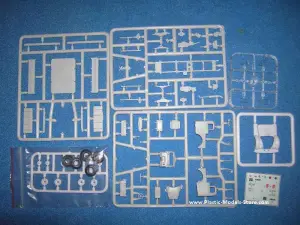
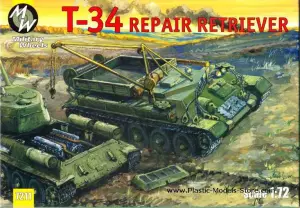
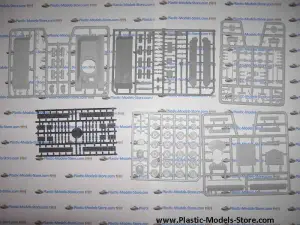
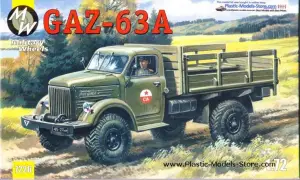
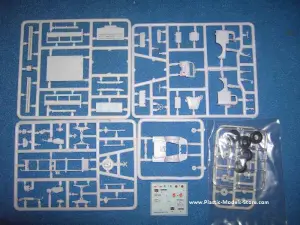
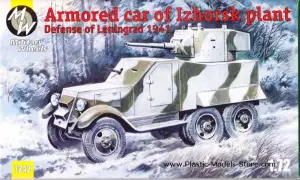
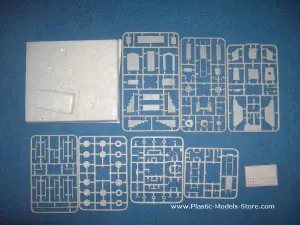
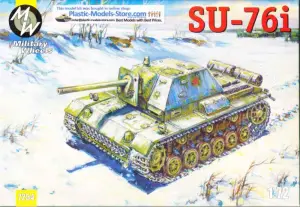
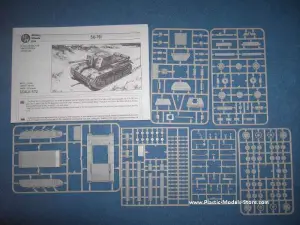
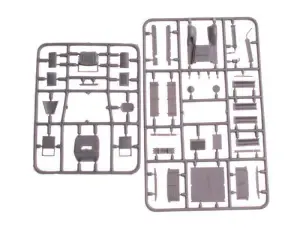
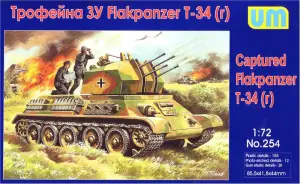
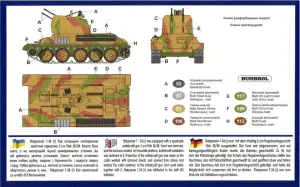
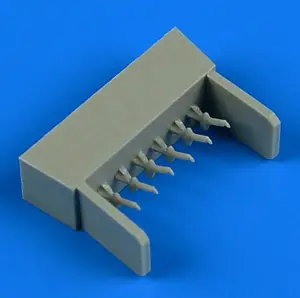
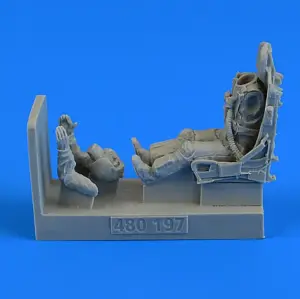
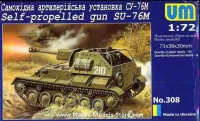
T-34/D-30 Egyptian 122mm self-propelled gun
1/72 WWII vehicle scale plastic model kit
Military Wheels 7232
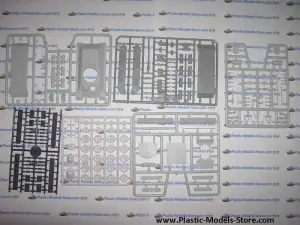
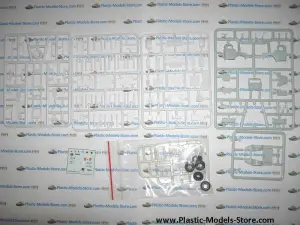
Finish: Unpainted, unassembled. The kit does not include paints or glue.
Throughout the Second World War the T-34 formed the core of Soviet armoured units. Its design and manufacture were refined repeatedly during the conflict to improve combat performance and lower production costs, so that ever larger numbers could be deployed despite heavy losses. It was the most produced tank of the war and, after its successor the T-54/55 series, the second most produced tank in history. By the war's end in 1945 the T-34 had supplanted many light and heavy tanks in the Red Army. It made up the bulk of Soviet tank output and was exported widely after the war. Its gradual evolution gave rise directly to the T-54/55 series, which was manufactured until 1981 and was still in operation as of 2013. That line in turn led to the T-62, T-72 and T-90, which, together with several Chinese tanks derived from the T-55, still form the backbone of many armies today. As late as 1996, T-34 variants remained in service in at least 27 countries. In 1937, ahead of the fighting with the Japanese Army, the Red Army tasked engineer Mikhail Koshkin with leading a fresh team at the Kharkiv Komintern Locomotive Plant (KhPZ) to develop a successor to the BT tanks. The prototype, designated A-20, carried 20 mm (0.8 in) of armour, a 45 mm (1.77 in) gun and the new Model V-2-34 engine, a V12 designed by Konstantin Chelpan that ran on less flammable diesel fuel. It also featured an 8×6 convertible drive similar to the BT's 8×2, allowing it to travel on wheels without tracks. This had greatly reduced maintenance and repair work on the unreliable tracks of the early 1930s and let tanks exceed 85 kilometres per hour (53 mph) on roads, though it offered no combat advantage. By 1937-38 track design had improved, and the designers regarded the wheel drive as wasted space and weight despite its road speed benefit. The A-20 also built on earlier research (the BT-IS and BT-SW-2 projects) through sloped armour: its all-round sloped plates were more likely to deflect rounds than vertical ones.
After the fighting with the Japanese Army, Koshkin persuaded Soviet leader Joseph Stalin to allow a second prototype, a more heavily armed and armoured "universal tank" incorporating the lessons of those battles and capable of replacing both the T-26 and the BT. Koshkin named this prototype A-32, after its 32 mm (1.3 in) of frontal armour. It carried an L-10 76.2 mm (3 in) gun and the same Model V-2-34 diesel. Both designs underwent field trials at Kubinka in 1939, and the heavier A-32 proved as mobile as the A-20. An even heavier version of the A-32, with 45 mm (1.77 in) of front armour, wider tracks and the newer L-11 76.2 mm gun, was approved for production as the T-34. Koshkin took the name from the year 1934, when he began developing his ideas for the new tank, and in commemoration of that year's decree expanding the armoured force and placing Sergo Ordzhonikidze in charge of tank production.
Lessons from Lake Khasan and Khalkhin Gol on armour protection, mobility, quality welding and main armament went into the new T-34, which marked a considerable advance over the BT and T-26 in all four areas. Koshkin's team finished two prototype T-34s in January 1940. In April and May they endured a gruelling 2,000-kilometre (1,200 mi) journey from Kharkiv to Moscow for a demonstration to the Kremlin leadership, then to the Mannerheim Line in Finland, and back to Kharkiv via Minsk and Kiev. A few drivetrain weaknesses were identified and corrected along the way.
United States · Airmail with tracking · delivery ~14 days.
Change the country in the shipping box above.
| Box weight (products) | Price |
|---|
| 0.00 lb – 0.49 lb | $8.90 |
| 0.49 lb – 0.97 lb | $12.99 |
| 0.97 lb – 1.94 lb | $19.99 |
| 1.94 lb – 220.46 lb | $22.99 |
| Order over $150.00 | FREE |
This product weighs 0.30 lb.
There are no reviews for this product yet.

 Black Friday−20%
4d 11h